> For the complete documentation index, see [llms.txt](https://help.seoutils.app/llms.txt). Markdown versions of documentation pages are available by appending `.md` to page URLs; this page is available as [Markdown](https://help.seoutils.app/guide/how-to-save-costs-when-using-dataforseo.md).
# How to Save Costs when Using DataForSEO
To save costs while using DataForSEO data on SEO Utils, consider implementing the following strategies:
### 1. Reusing Past Searches with Recent Searches & Local Cache
Every DataForSEO search you run is stored locally in your SQLite database. Under each tool's search bar, a **Recent searches** list lets you re-open past searches in one click — no API credits spent if the data is still cached. A small freshness widget in the bottom-right corner shows how old the data is and has a Refresh button for when you need the latest.
Read the instructions at: [Recent Searches & Cache](/guide/recent-searches-and-cache.md)
### 2. Using S3 Cache to Share Data
SEO Utils can cache DataForSEO API responses using S3-compatible storage (AWS S3, Cloudflare R2, DigitalOcean Spaces, MinIO), and the data is cached for up to 7 days. Your teammates can access the same data without paying any extra fees.
Read the instructions at: [S3 Cache for DataForSEO Data](/guide/data-sharing-with-s3.md)
### 3. Using Default Filters
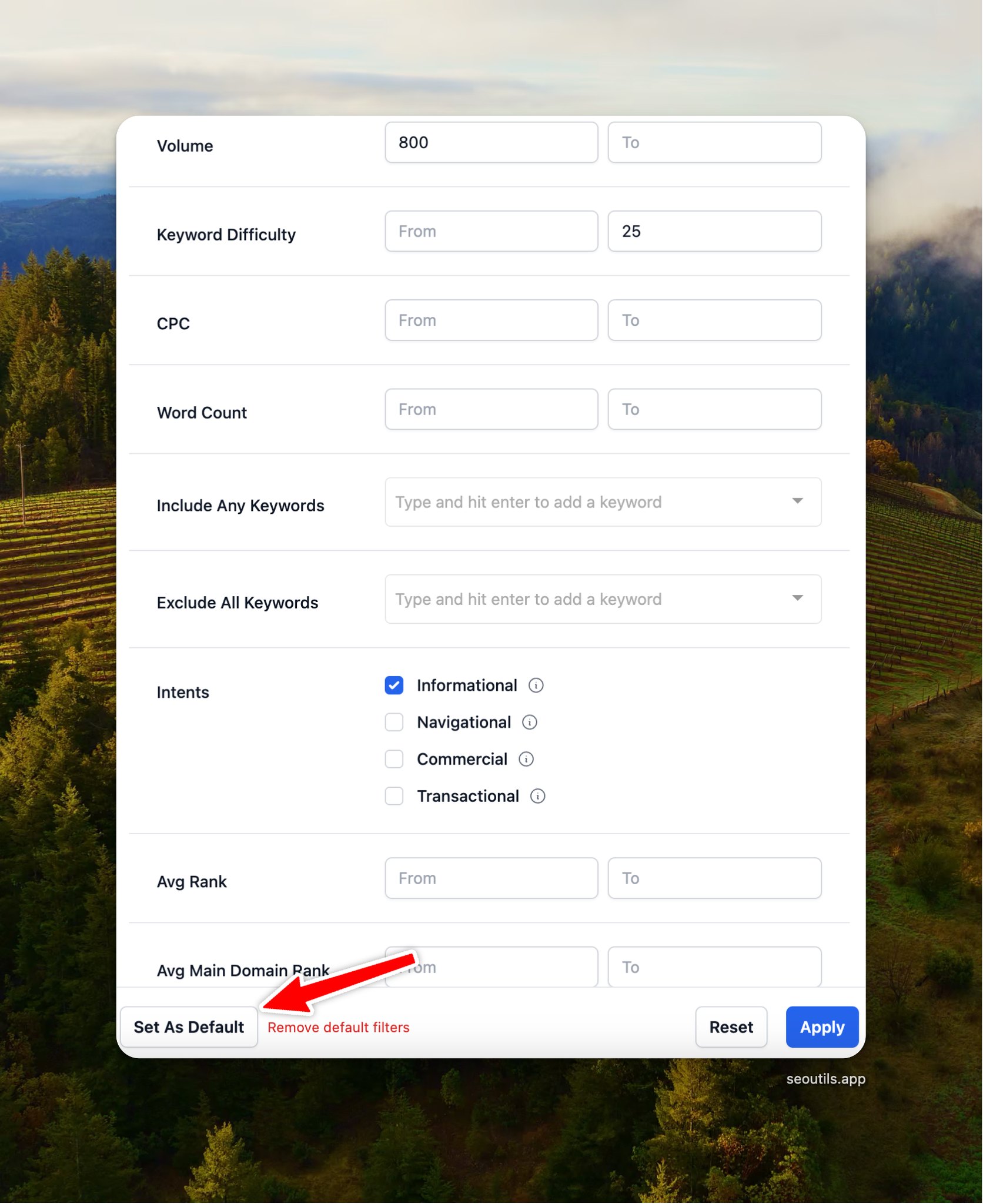
Since [v1.13.0](https://help.seoutils.app/guide/pages/FYHJNu9cAi74Qc90ALo7#v1.13.0), you will be able to set default filters for each request to DataForSEO. SEO Utils will apply those filters on the initial load, helping you save costs by avoiding pulling unneeded data.
For example, I often look for keywords that get searched at least **800 times per month**, have a **Keyword Difficulty of no more than 25**, and are used for **informational purposes**. I can set the default filters as shown in the following image.
Every time I visit the **Organic Keywords** page, the same filters will be applied during the initial loading.
Set default filters for the tool that pulls DataForSEO data to save costs.